


How Champion-Challenger Testing Prevents Portfolio Spikes
In high-volume lending, adjusting a credit threshold based on instinct is risky.
For Chief Credit Officers and risk leaders, the biggest concern is the portfolio spike: a sudden rise in delinquencies or drop in asset quality caused by a policy change that looked reasonable but failed in production.
To avoid this, lenders are moving away from static legacy platforms and toward modern risk management software. With Champion-Challenger testing and batch simulations, teams can see how a strategy performs before it ever goes live.
Instead of guessing, you can validate every change against real historical data.
Predict Your Results
Stop guessing and start knowing. Schedule a Technical Demo to see how QA Workbench simulates your strategy changes against a full year of applications.
Key Takeaways
- Portfolio spikes happen when strategy changes go live without validation
- Simulations show impact using historical applications
- Champion-Challenger testing confirms performance in real traffic
- Small test groups protect portfolio health
- Decisions are driven by outcomes, not assumptions
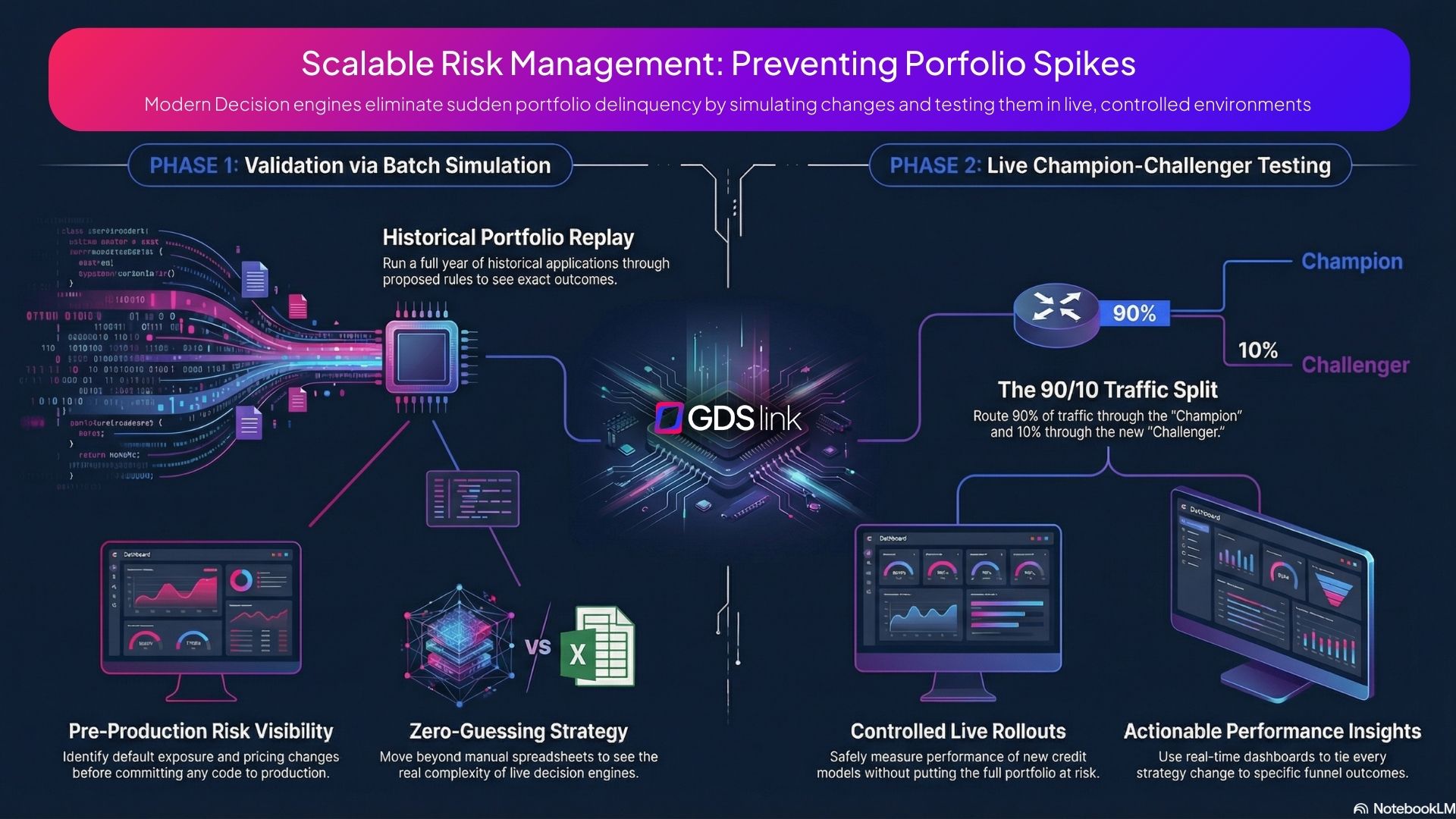
Eliminating the Fear of Portfolio Spikes with a Decision Engine
Credit teams often hesitate to adjust FICO cutoffs or debt-to-income thresholds because they cannot see the downstream impact.
Traditional testing methods, usually spreadsheets and manual modeling, fail to account for the real complexity of a live decision engine.
QA Workbench changes that.
You can run an entire year of historical applications through a proposed Challenger strategy and see exactly how each applicant would have been decisioned under the new rules.
This is not a forecast.
It is a replay of your portfolio.
You see approvals, declines, pricing changes, and default exposure before committing anything to production. That visibility allows teams to identify risk early and avoid unintended spikes before rolling out automated credit decisioning.
The Power of Champion-Challenger Testing: The 90/10 Split
Once a strategy is validated in simulation, the next step is live Champion-Challenger testing.
Traffic is split using a random number generator. For example:
- 90% continues through your existing Champion strategy
- 10% flows through a Challenger
This controlled rollout lets you measure real performance without putting the full portfolio at risk.
It is the safest way to test:
- New alternative credit models
- Different bureau configurations to reduce acquisition costs
- Conservative versus aggressive pricing and offer structures
Download the Roadmap
Ready to modernize? Download the Legacy Replacement Roadmap to learn how to move to a self-service decisioning environment.
Turning Data into Actionable Insights
Testing only matters if it leads to action.
The Policy Monitoring Dashboard provides near real-time visibility into your funnel. You can see where applicants branch into different paths and where manual reviews are introduced.
If a rule creates friction, Reason Code Simulation shows what happens when that rule is adjusted or removed.
Every change is tied to outcomes.
Teams stay focused on two goals:
- Increasing approvals
- Reducing operational overhead
All while staying aligned to risk appetite and portfolio targets.
Conclusion: Data-Driven Confidence
Modern credit strategy requires visibility before execution.
By combining historical simulation with live Champion-Challenger testing, lenders gain confidence to move faster without putting portfolio health at risk.
When you can see the impact of every policy change in advance, decisions become deliberate, measurable, and controlled.
That is how high-growth lenders scale safely.
Recent articles

5 Things to Look for in a Decisioning Partner When Legacy Systems Are Part of the Equation
Read article
Beyond Chatbots: Deploying AI Skills for Sub-Second Underwriting
Read article