

Beyond Brainstorming: 7 Proven Risk Identification Techniques for Complex Projects
Executive Summary
For CROs, CFOs, and Credit leaders, unidentified risk shows up as delayed launches, portfolio volatility, vendor exposure, and compliance findings.
Most teams still rely on informal brainstorming to identify project risks. That approach consistently misses systemic threats like contract dependencies, payment exposure, operational bottlenecks, and stakeholder misalignment.
Structured risk identification helps financial organizations:
- Surface vendor and integration risk early
- Reduce approval volatility during program launches
- Create audit-ready documentation
- Protect portfolio performance
- Accelerate delivery timelines
This guide outlines seven proven risk identification techniques used by financial institutions to reduce surprises, improve execution confidence, and support scalable growth.
Strengthen Your Risk Framework
If your team still tracks risk in spreadsheets, schedule a technical walkthrough to see how structured risk processes support audit-ready operations.
Understanding When Brainstorming Isn’t Enough
Brainstorming works for small projects with limited financial exposure.
It breaks down when:
- Teams are distributed
- Vendor relationships introduce dependency risk
- Financial impact requires documentation
- Regulatory oversight demands traceability
- Credit programs involve multiple integrations
In lending and embedded finance, missed risks become approval swings, delayed go-lives, and manual intervention.
Structured risk identification provides:
- Broader coverage across technical and financial domains
- Reduced bias in decision making
- Documentation that holds up in executive reviews
Reduce Delivery Risk Before Launch
See how structured risk identification fits into modern credit and operations workflows.
Common Use Cases for Structured Risk Identification
Financial teams apply these techniques when:
- Launching new lending programs
- Managing vendor-heavy initiatives
- Implementing decisioning or payment platforms
- Supporting regulatory reviews
- Scaling underwriting operations
Structured approaches help uncover:
- Vendor credit exposure
- Payment flow concentration
- Operational bottlenecks
- Integration dependencies
- Compliance gaps
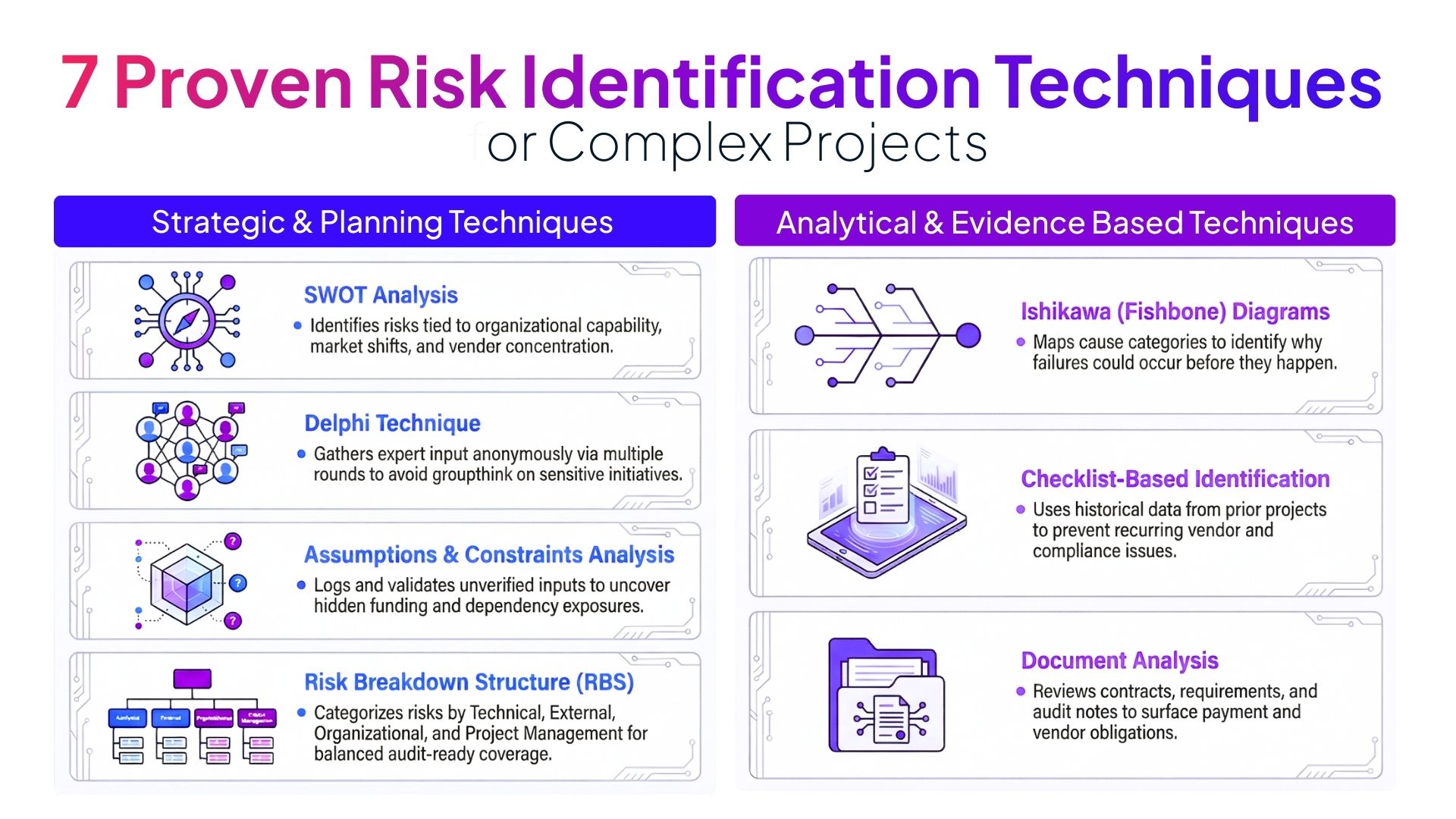
Technique 1: SWOT Analysis for Strategic Risk Context
Use SWOT to identify risks tied to organizational capability, market shifts, and vendor concentration.
When to use it: project initiation, portfolio planning, market changes
How to run it: list Strengths, Weaknesses, Opportunities, Threats, then convert each item into risk register entries
Best for: strategic risk, capability gaps, vendor and financial exposure
Technique 2: Delphi Technique for Expert Consensus
Use Delphi to gather expert input anonymously and avoid groupthink.
When to use it: sensitive initiatives, distributed teams, specialized expertise
How to run it: Round 1 risk collection, Round 2 scoring, Round 3 prioritization
Best for: technical risks, contract concerns, emerging threats
Technique 3: Ishikawa (Fishbone) Diagrams for Root Cause Analysis
Use fishbone diagrams to identify why failures could occur before they happen.
When to use it: quality risk, process risk, complex integrations
How to run it: define failure event, map cause categories, ask “why” until root causes appear
Best for: operational breakdowns, multi-cause failures
Technique 4: Checklist-Based Identification Using Historical Data
Turn past project failures into repeatable prevention.
When to use it: regulated environments, recurring project types
How to run it: extract risks from prior projects and review systematically
Best for: vendor issues, compliance risk, delivery delays
Technique 5: Assumptions and Constraints Analysis
Unverified assumptions create hidden exposure.
When to use it: early planning and milestone reviews
How to run it: log assumptions, validate inputs, convert gaps into risks
Best for: funding risk, resourcing constraints, dependency exposure
Technique 6: Document Analysis and Lessons Learned Review
Contracts often contain risk signals.
When to use it: contract-heavy projects, compliance initiatives
How to run it: review agreements, requirements, audit notes
Best for: payment exposure, vendor obligations, scope ambiguity
Identify Contract Risk Early
Learn how financial teams surface payment and vendor exposure before contracts are finalized.
Technique 7: Prompt Lists and Risk Breakdown Structure (RBS)
RBS ensures balanced risk coverage.
When to use it: workshops, executive reporting, risk register design
How to run it: categorize risks by Technical, External, Organizational, Project Management
Best for: audit-ready structure, reporting clarity
Creating Your Risk Identification Strategy: Combining Techniques
A practical sequencing approach:
- Start with SWOT + Assumptions Analysis
- Before contracts lock: Document Review
- Distributed expertise: Delphi
- Known failure points: Fishbone
- Coverage validation: RBS
- Ongoing: Historical checklists
Operationalize Risk Identification
See how modern platforms centralize ownership, documentation, and reporting across these techniques.
Practical Implementation Tips
- Write risks using cause, event, impact
- Separate identification from response planning
- Tag risks with RBS categories
- Treat your risk register as a living operational tool
Frequently Asked Questions
What is risk identification in financial projects?
Risk identification finds potential events that could impact delivery, compliance, revenue, or portfolio performance.
Why is brainstorming insufficient?
It misses vendor exposure, financial dependencies, and contractual risk.
What is a Risk Breakdown Structure?
An RBS categorizes risks to ensure coverage across technical, organizational, and external threats.
Conclusion
For credit and finance leaders, risk identification directly impacts portfolio stability, operational efficiency, and regulatory confidence.
Brainstorming alone leaves gaps in vendor exposure, payment risk, and delivery dependencies.
The seven techniques in this guide provide structured coverage while creating documentation that stands up to audit and executive review.
High-performing organizations identify risks early, act before issues materialize, and protect both growth and portfolio quality.
You do not need to replace your existing process. Start with one technique. Expand where risk is highest.
Build Audit-Ready Risk Operations
Explore Solutions
Request a Demo →
Recent articles

5 Things to Look for in a Decisioning Partner When Legacy Systems Are Part of the Equation
Read article
Beyond Chatbots: Deploying AI Skills for Sub-Second Underwriting
Read article